Stop "Participation Washing". Activate Collective Intelligence.
For researchers, public officials, and activists who know there’s a better way to build our cities together.
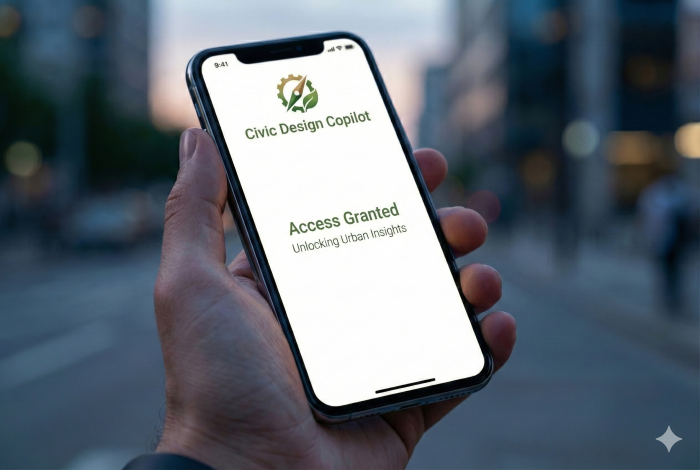
This campaign has a dual mission. First, we are funding the production of the definitive physical handbook: Civic Design. Second, if we reach our stretch goal, we will develop the Civic Design Copilot, an AI assistant to help you apply these tools in real-time.
The Problem: The "Post-it" Trap
We have all been there. Public institutions often feel like rigid, slow structures, while citizens move quickly and spontaneously.
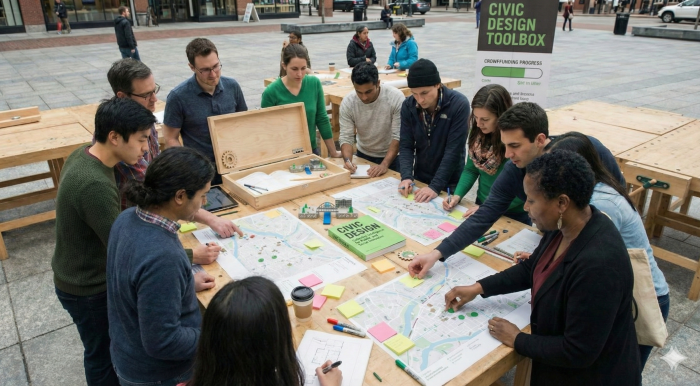
We attend meetings, we stick post-its on walls, we take a photo... and then? Often, nothing changes. This is "Participation Washing": processes that look collaborative on the surface but fail to transform reality.
The disconnect causes frustration for citizens and paralysis for institutions. We don't need more theory about why we should collaborate. We need professional tools to show us how to do it.

The Solution: A "Phygital" Ecosystem
This project moves beyond traditional academic texts to offer a comprehensive framework for action. We are proposing a hybrid ecosystem to bridge the gap:
1. The Compass: The Physical Book (Base Goal)
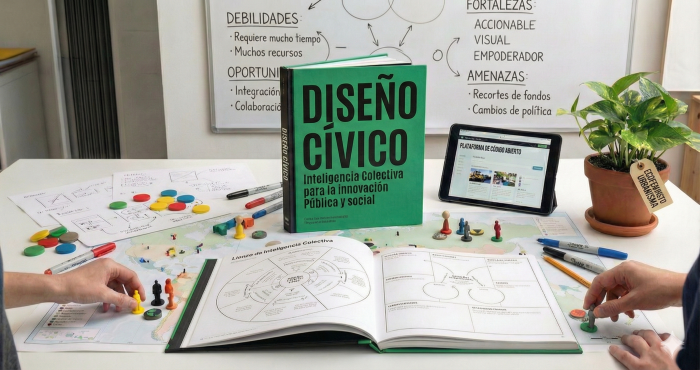
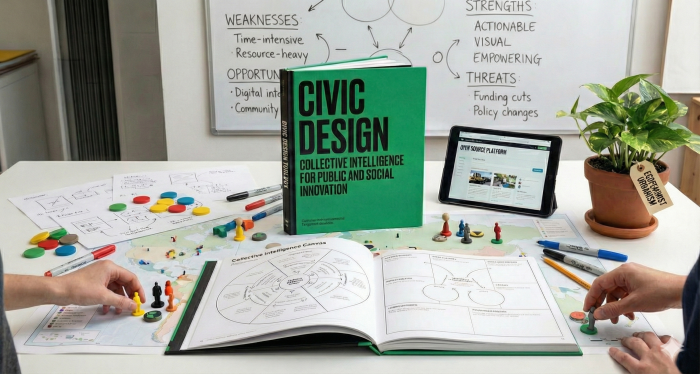
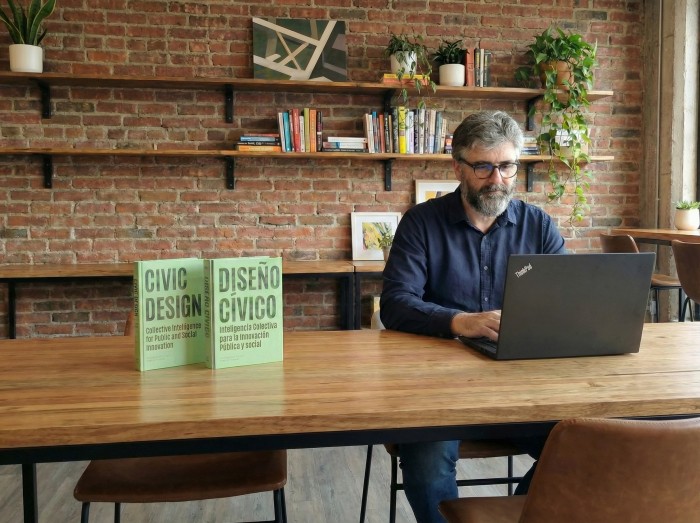
Civic Design is not a book to read on the couch; it is a workbook for the field. Inside, you will find:
The Collective Intelligence Canvases: Visual tools to map resources and stakeholders.
The Circular Process: A step-by-step guide to structure participation.
The Civic Scope Matrix: How to prioritize actions in complex environments.
2. The GPS: The AI Copilot (Stretch Goal)
Unlocked only if we reach €16,000.
Imagine having the methodology in your pocket. We want to develop a specialized AI trained exclusively on the book’s principles.
What it does: It acts as your 24/7 consultant. Ask it how to engage a hostile community or how to draft a workshop agenda, and it will generate a strategy based on the Civic Design framework.
How to get it: All backers who pledge €30 or more (or buy the physical book) will receive a lifetime license.
Main features and goals of the crowdfunding campaign
Civic Design is not just a publication; it is a "Phygital" Ecosystem (Physical + Digital) designed to modernize how we build our cities.
While most urbanism books are theoretical essays that sit on a shelf, this project offers a practical battle manual. It bridges the critical gap between the rigid structures of public institutions and the spontaneous energy of citizen activism. Its main differentiator is the integration of Collective Intelligence with Artificial Intelligence: we are not only publishing a physical workbook with visual canvases but also developing the "Civic Design Copilot," a custom AI assistant trained to help professionals apply these methods in real-time.
Project Objectives
-
To publish a premium, high-quality physical edition of Civic Design: Collective Intelligence for Public and Social Innovation, designed as a durable workbook for field use.
-
To develop and launch the "Civic Design Copilot," a specialized AI tool that acts as a real-time consultant for local leaders and municipal technicians (Stretch Goal).
-
To equip citizens, activists, and public servants with a shared language and visual tools (such as the Co-Design Canvas) to move from confrontation to collaboration.
-
To democratize urban innovation by releasing the core methodological diagrams and canvases under Creative Commons licenses, ensuring they are accessible to communities worldwide.
-
To transform passive residents into active "City Producers," providing them with the professional rigor needed to influence public policy effectively.

The Civic Design Framework
Moving beyond "Participation Washing" requires a new vocabulary. Here are the core concepts that define our methodology.
1. Collective Intelligence vs. Representativeness
The Shift: We stop asking "Who represents whom?" and start asking "What can we solve together?"
Traditional politics relies on Representativeness (a few people deciding for the many, often leading to conflict). Civic Design relies on Collective Intelligence (aggregating the diverse knowledge of the community to find better solutions). We don't just want citizens to vote; we want them to think and build.
2. The "Phygital" Ecosystem
The Context: The city is no longer just physical; it is hybrid.
Civic Design operates in the "Phygital" realm (Physical + Digital). A town hall meeting is limited by time and space; a digital platform is often cold and detached. We design "Third Spaces"—hybrid environments where digital connectivity enhances physical encounters, ensuring participation is continuous, inclusive, and accessible.
3. From "Protest" to "Proposal" (The City Producer)
The Actor: Transforming passive residents into active agents.
A citizen is often treated as a customer or a voter. In Civic Design, we view them as City Producers. We equip communities with professional tools (like the Co-Design Canvas) to help them channel their frustration into viable, technical proposals that institutions can actually implement.
4. Situated Intelligence
The Approach: Global tools, local solutions.
There is no "copy-paste" in urbanism. What works in Medellin might fail in Madrid. Situated Intelligence means deeply understanding the specific cultural, spatial, and social context of a territory before drawing a single line. Our methodology teaches you how to map these unique assets (using the Civic Scope Matrix) to create solutions that stick.
5. The Circular Process
The Method: Participation is not a linear path; it is a continuous cycle.
To avoid the "dead-end" of traditional workshops, we follow a rigorous four-stage cycle:
- Situate: Understand the context and map actors.
- Socialize: Build trust and expand the network.
- Co-Design: Prototype solutions collectively.
- Implement: Build, test, and learn—then start again.
Why this is important

This project is born from a recurring frustration I have witnessed over 20 years of working on the ground, from the neighborhoods of Buenos Aires to the municipal offices of Madrid and Paris.
Everywhere I went, I saw the same paradox:
- Citizens have an immense desire to improve their environment but often lack the technical language to have their proposals taken seriously.
- Public Institutions want to innovate, but they are trapped in rigid, bureaucratic structures that turn participation into a slow, administrative burden.
I realized that we are surrounded by "Participation Washing": meetings full of sticky notes and good intentions that end up in a drawer. This generates cynicism in citizens and burnout in public servants.
I wrote this book because I got tired of the theory.
I wanted to stop talking about why we should collaborate and start documenting how to do it. I needed to compile the tools, canvases, and protocols that I have tested in the real world into a single manual for action.
This project is my attempt to provide a common language. I want to replace the "battle" between activists and institutions with a "construction site" where we all have the right helmet and the right blueprints.

Who is this for?
This "Phygital Ecosystem" (Book + AI) is designed for a transversal tribe of people who refuse to be mere "users" of their cities. It is specifically written for:
- 🏛️ The Frustrated Public Servant:
You work inside the administration. You know the system is too slow, and you are looking for agile, professional methodologies to justify innovative processes to your superiors and foster genuine participation.
- 📢 The Neighborhood Leader & Activist:
You have the energy and the community, but you need structure. This book gives you the strategic tools to organize your proposals, map your ecosystem, and sit at the negotiation table with professional rigor.
- 📐 The Architect & Urban Planner:
You realized that designing physical spaces is no longer enough. You need to learn how to design social processes. This manual adds the "Civic Layer" to your technical skills, helping you create spaces that are truly adopted by the community.
- 🎓The Researcher & Student:
You are looking for a contemporary framework that connects the classic theories of the "Right to the City" with the digital reality of the 21st century (AI, Hybrid Spaces, Glocal Networks).
If you believe that making the city is a collective task that requires empathy, strategy, and the right technology, then you are already a Civic Designer. This toolkit is for you.

Frequently Asked Questions (FAQ)
📚 THE BOOK & LANGUAGES

In which language is the book available?
The book is available in both English and Spanish.
We are printing two separate editions. You do not need to choose the language now. Once the campaign ends, we will send a survey to every backer where you will be able to select your preferred language (English or Spanish) and confirm your shipping address.
Is the content the same in both versions?
Yes. The methodology, the diagrams, and the case studies are identical. The translation is being handled by professionals in the field of urban planning to ensure technical accuracy in both languages.
I bought the "Super Early Bird" reward. Can I still choose the English version?
Absolutely. The reward tier determines the price and the perks, not the language. You will choose the language (English or Spanish) after the campaign closes, regardless of which reward you selected.
🤖 THE CIVIC DESIGN COPILOT (AI APP)

🤖 How do I get access to the AI App?
The Civic Design Copilot is a Stretch Goal. This means we will develop the software only if the campaign reaches the €16,000 milestone.
If we reach this goal, all backers who pledged €30 or more (including all physical book tiers) will receive a lifetime access license for free.
What happens if you don't reach the €16,000 goal?
If we reach the minimum goal but not the optimum (€16,000), the project goes ahead, but we will focus exclusively on producing the Physical Book. The AI App will not be developed at this stage, and you will receive the book and the digital rewards (PDFs) as promised.
Does the AI work in other languages?
Yes. Since it is built on advanced Large Language Models (LLMs), the Civic Design Copilot will be able to interact with you in English, Spanish, French, Italian, and Portuguese, adapting to your local context.
📦 SHIPPING & LOGISTICS

When will I receive my book?
We estimate that production (final layout, proofreading, and printing) will take approximately 3 months after the campaign ends.
Digital Rewards (PDF): Estimated delivery: [April 2026]
Physical Books: Estimated delivery: [June 2026]
Do you ship worldwide?
Yes. We ship globally.
Spain & Europe: Shipping is optimized and fast.
Rest of the World: Please note that shipping costs are higher, and delivery times may vary depending on local customs.
Important: If you selected the Super Early Bird reward, please check the restriction (Europe only).
Are shipping costs included in the pledge?
Yes
💼 FOR ORGANIZATIONS & COMPANIES

Can I get an invoice for my company/institution?
Yes, absolutely.
Since this is a professional manual, many backers claim it as a business expense. Once the campaign ends, you will be able to request a formal invoice with all our tax details (VAT/Intracommunity VAT) through the backer survey.
I want to buy a bulk pack (10+ books) for my university or department. Is there a discount?
Yes. We have designed the "Strategic Partner" and "Consultancy Pack" tiers specifically for organizations. These packs include a bulk discount, training sessions, and logo visibility. If you need a specific quantity not listed, please contact me directly.
Team and experience

Domenico Di Siena is an international expert and arguably the leading global voice on Civic Design.
With over 20 years of experience, his career is defined by a unique ability to bridge worlds. He has successfully advised major international NGOs (such as the UNDP and the Inter-American Development Bank), collaborated with prestigious universities across Europe and Latin America, and guided public institutions through complex transformation processes. Beyond the institutional realm, he has launched successful social innovation enterprises and civic organizations.
Expert in Community Activation & Third Spaces Domenico is a pioneer in "Situated Collective Intelligence." He specializes in activating communities by blending the digital and the physical. He has led the creation and activation of "Third Spaces" (hybrid citizen labs and collaborative hubs) across France and Spain, proving that genuine participation requires new spaces for encounter.
He is the instigator of the CivicWise network and currently serves as the Community and Membership Lead at Democratic Society.
Why trust this project? This methodology is not a hypothesis; it is the result of years of field testing. From the Dreamhamar process in Norway to the Civic Innovation School, and his work activating digital and physical communities globally, these tools have been refined in the real world. Now, they are ready for you.




 Channel